Date-Night Seafood: Crab Cakes Over Scampi Pasta
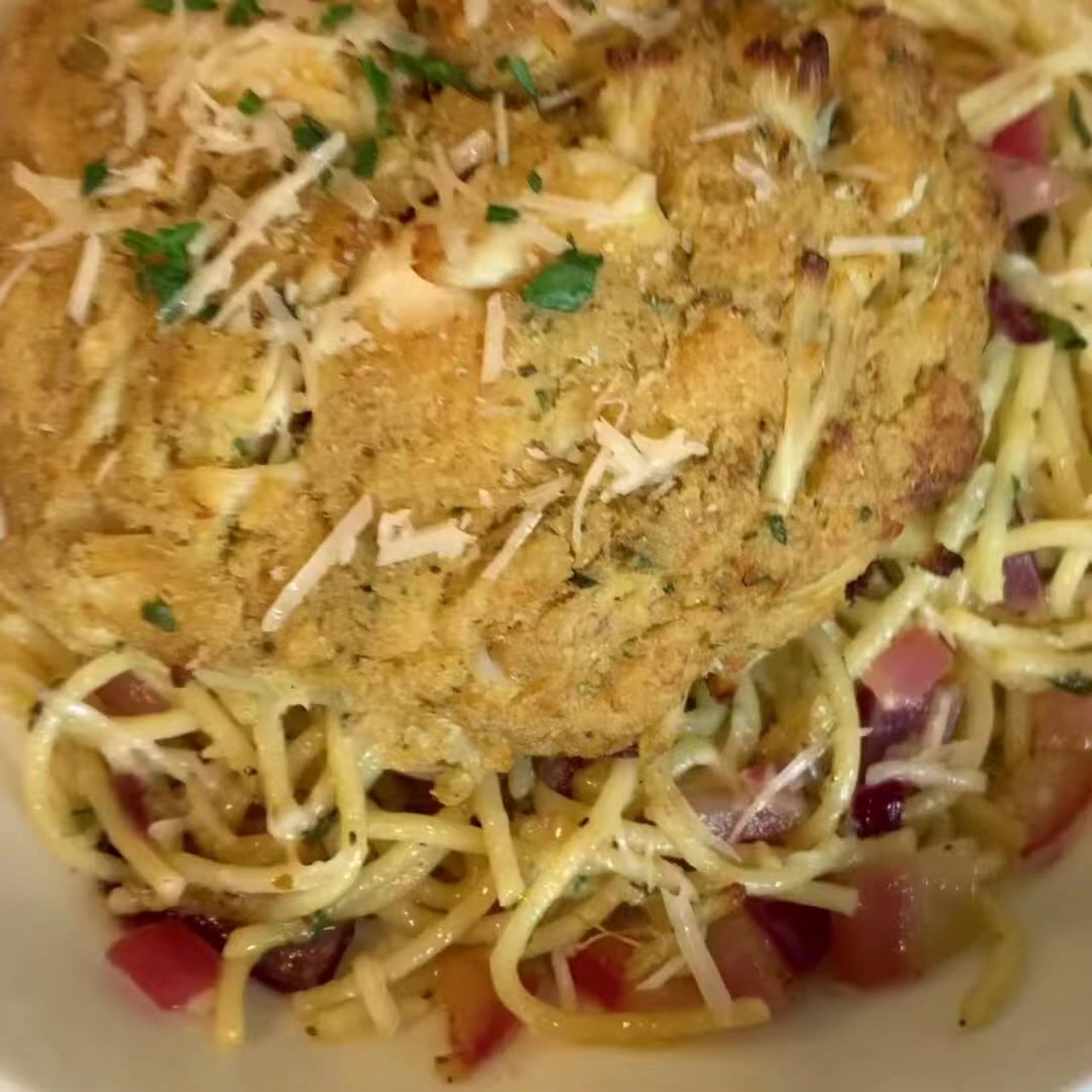
"Today we're going to be learning how to make a crab cake scampi, homemade crab cake." That's how it opens on camera, and the name undersells what's actually happening on the plate. My crab cake scampi is two full-size crab cakes, baked instead of fried, set on top of a from-scratch scampi pasta built around a proper reduction of white wine. Crab cakes as the protein moment, scampi pasta as the base — it's not a pairing you see very often, and that's exactly what makes it feel like an actual date-night plate instead of another skillet dinner.
Two crabs, two cakes, and the oven instead of the fryer
The crab mix uses two different kinds of crab meat on purpose — 8 ounces of lump crab meat and 8 ounces of "special" crab meat, folded in after the egg, mayonnaise, Old Bay, garlic powder, and Dijon mustard are already whisked together. That's a full pound of crab between the two, and instead of portioning it out into a handful of small patties, it gets formed into exactly two big cakes, about 8 ounces each — you can see the two of them sitting on the tray before they go in. They go onto a baking sheet and into a 450°F oven for 10 to 12 minutes. No oil, no skillet — baked, not fried.
Fold, don't stir
The instruction that matters most in that mixing bowl isn't an ingredient, it's a motion. "Try not to break up the lump crab meat" comes up twice — once as the two crab meats go into the bowl, and again right after the oyster sauce is stirred in, this time followed by "you don't want to break that up... just give it a light little whisk." The move is a light whisk, not a hard stir, keeping the crab in visible lumps instead of breaking it down into a paste. Breadcrumbs go in last, once the crab is already folded together.
"Burn out the wine" before anything else joins the pan
The scampi starts with olive oil and butter in a heated skillet, kept moving so the butter doesn't burn. Then a half cup of white wine goes in, and it works alone before a single other ingredient touches the pan: "make sure that you burn out the wine and make sure you cook it down until it starts to thicken up and condense." Only once the sauce has actually started to thicken does the red onion go in, along with diced tomatoes, followed by the rest of the build in order — Old Bay, salt and pepper, minced garlic, Parmesan, and parsley — stirred together until the sauce thickens up again at the end. Skip the wine reduction and the sauce never gets its body; every ingredient after it is leaning on that step already being done.
Old Bay, twice
Old Bay shows up on both sides of this dish, at the same amount — 2 teaspoons whisked into the crab cake mix, and 2 teaspoons stirred into the scampi later. It's not one seasoning carrying two components; the cakes and the sauce are built and seasoned as two separate things that happen to reach for the same tin.
The noodle call, and the swap that's actually in the description
Thin spaghetti is what's in the pan on camera, tossed into the finished scampi sauce right before the crab cakes go on top. But the choice is left open: "It's up to you what noodles you use... you can also use angel hair spaghetti. That's actually really good with this as well." The written recipe in the video's description carries its own swap, too — in place of the teaspoon of oyster sauce that goes into the crab mix on camera, the description lists a teaspoon of Worcestershire sauce instead. Either one works as the savory, umami binder holding the cakes together; it's a stand-in, not a downgrade.
A bonus move from a sister recipe: season before you stuff
If you like the idea of crab and seafood sharing a plate but want a smaller, individually portioned version instead of two full-size cakes, my crab-stuffed salmon bites are worth borrowing a trick from. That recipe cuts a salmon fillet into roughly 1-inch squares, then cuts a "T" slit into the middle of each one to open a pocket for a seasoned crab filling. Order matters here, and I learned it the hard way on camera: I stuffed my first batch of salmon squares before seasoning them, had to pull the filling back out, season the salmon, and restuff each square — "I got ahead of myself a little bit. I started stuffing it before I seasoned it, so I had to take it out." Season the salmon first, then stuff it. That crab filling gets a 30-minute fridge chill before it goes anywhere near the salmon, and once the squares are stuffed they go skin-side down into the air fryer at 300°F for about 9 to 12 minutes, finished with a lemon garlic butter sauce on top — not dramatically faster than baking the two big cakes, just a different, smaller-format way to get crab and seafood on the same plate.
More date-night seafood from the same kitchen
If baked crab cakes and a wine-reduced scampi are your speed, a few other dishes in my rotation run the same lane. My garlic butter crab-stuffed shrimp stuffs that same lump-crab instinct into butterflied shrimp, baked standing up and finished with a garlic butter drizzle. My fresh salmon patties go the opposite direction — real salmon from the seafood counter, baked first, then dredged and fried into croquettes instead of an oven-only cake. And if you want a date-night dinner that isn't seafood at all, my ribeye with lemon-Parmesan cream sauce is the steakhouse-at-home version of the same idea — one deliberate protein, given more care than a weeknight dinner usually gets.